Maternal Lineage: The Ancient Fire Beyond Surnames
By Jeane Satie | June 29, 2026
I discovered that we carry within us an ancient fire.
Not the one written on papers, announced by surnames, or proudly displayed on house facades. But another one. Silent. It inhabits the intimate core of every cell of mine like a flame that cannot be seen, yet warms, moves, and keeps us alive.
This is the true essence of maternal lineage — an ancient fire that no surname can contain.
Mitochondrial DNA: The Science of the Maternal Lineage
Immersed in the mysteries of science that is also poetry, I discovered that within us exists a DNA that doesn’t mix. Doesn’t dilute. Doesn’t negotiate. It is mitochondrial DNA — the engine of every cell, the spark that keeps us alive.
And it passes only from mother to daughter.
While nuclear DNA — the one that carries the surname, the height, the facial features — gets shuffled, remade, and lost along the path of generations, the mitochondrial one goes straight. Like a thread of light. Like a line that no one erases.
he man? He receives. But he doesn’t pass on. He’s the final point. The woman is ellipsis…
We are the ones who keep the wiring lit. Those who generate. Those who transmit. Those who carry in the body not just blood, but fire.
Expressing Maternal Lineage Through Visual Art
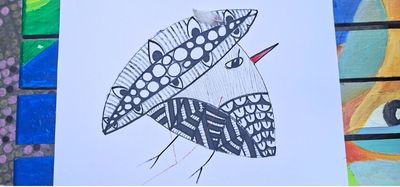
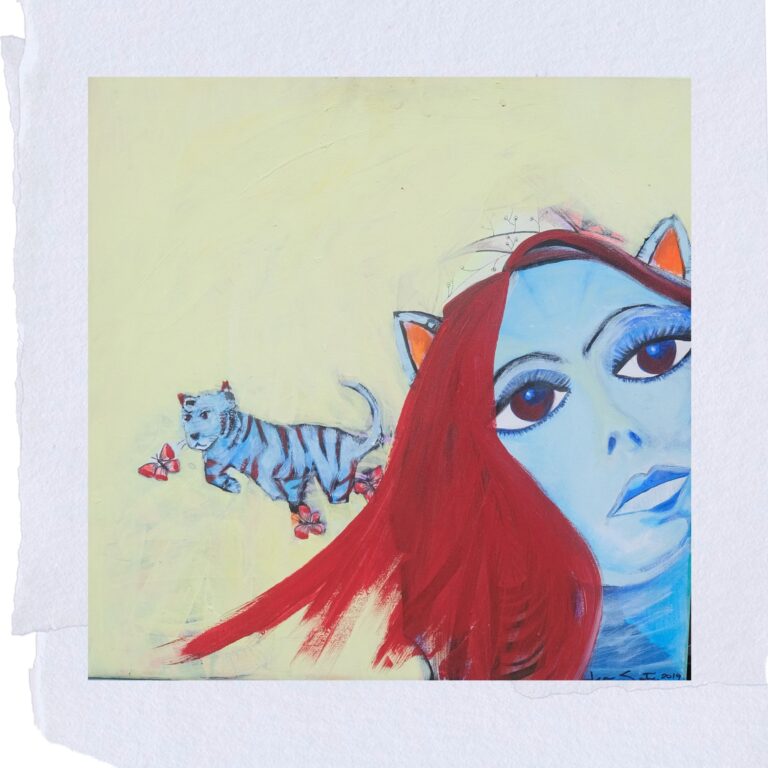
Today, I paint my Godivas. I create my Birds of Beirut.
And I understand: my art is not mine. It is theirs. Of all the women who came before, who crossed seas, wars, borders, pains, and kept this spark alive so that I could be here. Creating. Feeling. Existing.
The Godivas series was born from this same understanding of maternal lineage — women who refuse to be silenced, carrying forward an unbroken chain of voices. As a mother artist, my canvas is simply an extension of this ancient fire.
Aisha and the Continuation of the Mother Artist Journey
Aisha is my first work of art.
In her flows not just my blood. The engine flows. The one that resisted. The one that didn’t go out. The one that reached me so I could deliver it to her, intact, as it was delivered to me.
My daughter, now in Moscow, carries this same maternal lineage — a fire that crosses borders without losing its heat.
Read more about my journey as a mother and artist navigating life and creativity
The True Inheritance: Birds, Women, and Unbroken Threads
The surname? Ah, the surname…
t’s just a footnote. A formality. Something written on documents and forgotten in drawers.
The true inheritance is this light that doesn’t negotiate. That doesn’t mix. That doesn’t go out.
I invent birds that no one hunts. Women that no one ignores.
And I do all this with the energy I received. That is mine. That is theirs. That will be hers.
An unbroken thread. A spark. A fire that has no surname — because it has something infinitely more powerful:
It has life.
“Have you ever stopped to think about the ancient fire you carry, long before any name?”