The Sensory Vacuum— or why I paint what I cannot say
First of all, what is the sensory vacuum?
What is the sensory vacuum? It is that dense space between languages, where longing, resilience, and identity collide — and where my art begins.
The philosopher Ludwig Wittgenstein once wrote one of the most piercing remarks in modern thought:
“The limits of my language mean the limits of my world.”
At first glance, this sounds like a cage. As if, without words to name an experience, it would remain invisible — swallowed by silence. However, what happens when life throws you right into the middle of the map — into the tangle of languages that intersect, collide, and so often fail to translate what you carry?
Growing up in the in-between
I grew up in the in-between. Portuguese carries the warmth of affection. Arabic brings the weight of ancestry. French offers a different cadence, a different breath. And still, there are moments when the sum of all the dictionaries in the world leaves a deficit of silence.
A void.
Therefore, I chose to call this space the sensory vacuum.
Not absence, but excess
Importantly, this is not absence. Rather, it is excess. It is the dense baggage of longing, resilience, farewells, and new beginnings that simply doesn’t fit into the square structure of a grammatically correct sentence. Trying to explain with ordinary words what it means to plant roots in lands that constantly rebuild themselves — well, it’s like trying to hold the sea between your fingers.
In other words, logical language hits the wall. And crumbles.
The sensory vacuum in my art
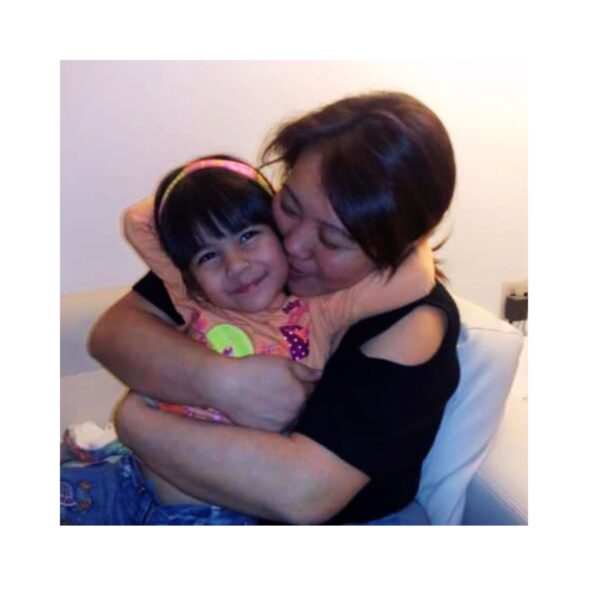
I remember an afternoon when I tried to describe my grandmother to someone. Not her appearance — but the little pats on my back when she hugged me, the smell of the futon washed with care, the way she pronounced my name as if it were a prayer.
I tried. I used every word I had. And yet, I left the conversation feeling like I had told everything but said nothing.
That’s when I understood: some things are not meant to be said. They are meant to be shown. This is precisely the sensory vacuum I paint.
Painting as translation
It is at this edge — where words fail — that art demands entry. For me, painting is not illustrating. Instead, it is translating the invisible. My art is born and breathes within this sensory vacuum. Where the mouth falls silent and the mind fails to label, raw matter takes control.
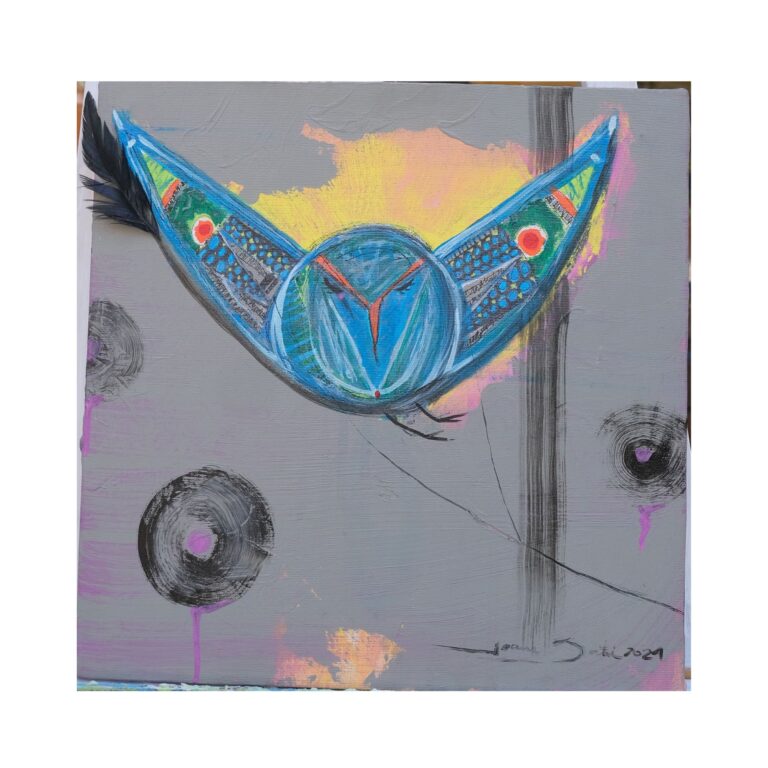
Consequently, the birds and the Godivas give me the voice of silence.
When language reaches its limit
When language reaches its limit, I do not accept being muted. I change the game.
What cannot be said in verbs gains wings. Moreover, it gains colors that exist in no dictionary. It also gains the essential nudity of those figures that inhabit my canvases — with contours that never close, because the soul accepts no frames, and identity is always in motion.
Looking at a canvas, I see an inner landscape that no words could ever encompass. My grandmother’s little pats on my back resurface. The smell of the futon washed with care returns. The sound of the sea in another language echoes. Everything that was left out of every conversation I ever had finally finds its place.
Art as the infinite border
If the limits of language are the limits of the world, then art is the instrument that pushes those borders toward the infinite. The sensory vacuum is not empty — on the contrary, it is full of unsaid things.
Therefore, it does not come to fill the vacuum with noise or explanations. Rather, it comes to give body to the unspeakable. To make you, looking at a canvas, finally hear what no name in the world has ever been able to explain.
The many faces of silence
Because there are silences that scream. Others comfort us deeply. And some, finally, heal.
In the end, there are things that logic will never decipher — but that sensitivity will always be able to embrace.
And you? Have you ever felt this vacuum? What do you do when